
Our Products
Home - About
CD Dryer and BD Dryer
How do desiccant dryers work?
Desiccant dryers consist of two towers filled with desiccant such as activated alumina, molecular sieves or silica gel. Wet compressed air passes directly through the substance, which adsorbs the moisture. The desiccant has a finite adsorption capacity before it must be dried out. Hence the twin tower design. While one tower is drying air, the other is being regenerated.
Atlas Copco offers two types of desiccant dryers, the BD+ range of blower (zero) purge dryers and the CD(+) series of heatless desiccant dryers. The difference lies in their regeneration process.
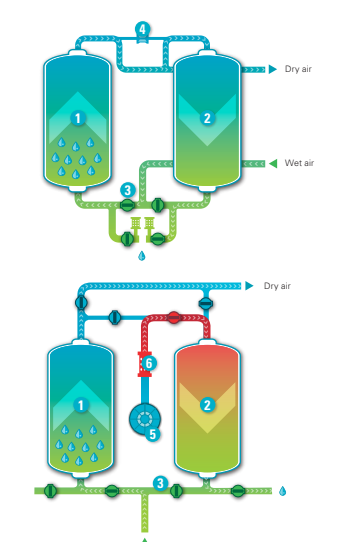
1. Drying
Wet compressed air flows upward through the adsorbent desiccant from bottom to top (1).
2. Regeneration
Heatless desiccant dryers – CD+:
Dry air from the drying tower outlet is expanded to atmospheric pressure and sent through the saturated desiccant, forcing the adsorbed moisture out (2 and 4).
After desorption, the blow-off valve is closed and the vessel is re-pressurized.
Blower (zero) purge desiccant dryers – BD+:
The blower (5) takes ambient air and blows it across the external heater (6). The heated air is then sent through the saturated desiccant (2), forcing the adsorbed moisture out.
3. Cooling (BD+)
BD+ with purge:
After the heating phase, the desiccant is cooled by expanding dry compressed air from the outlet of the adsorbing vessel over the hot reactivated tower.
BD+ with zero purge:
After the heating phase, the blower takes in ambient air and sends it through the reactivated tower from bottom to top.
4. Switching
After regeneration, drying switches from the saturated tower to the regenerated tower (3).
Atlas Copco desiccant dryer range
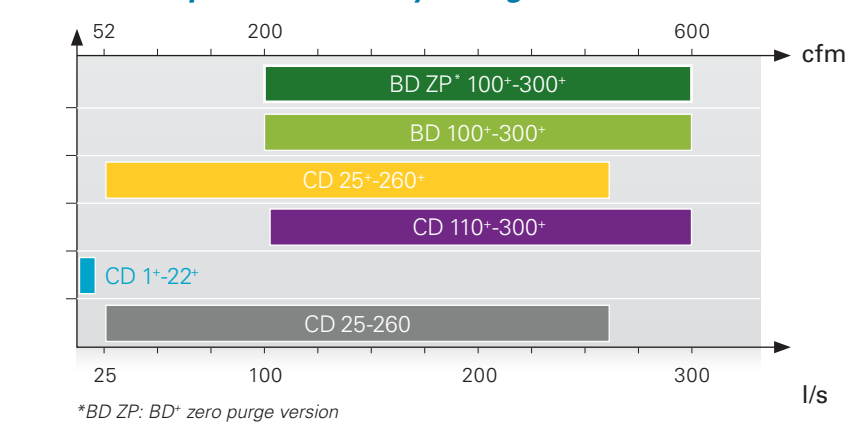
Which Atlas Copco desiccant dryer is right for you?
With the BD+ blower (zero) purge dryers and CD(+) heatless desiccant dryer series, Atlas Copco offers a desiccant drying solution to meet your exact needs.
Lifecycle cost
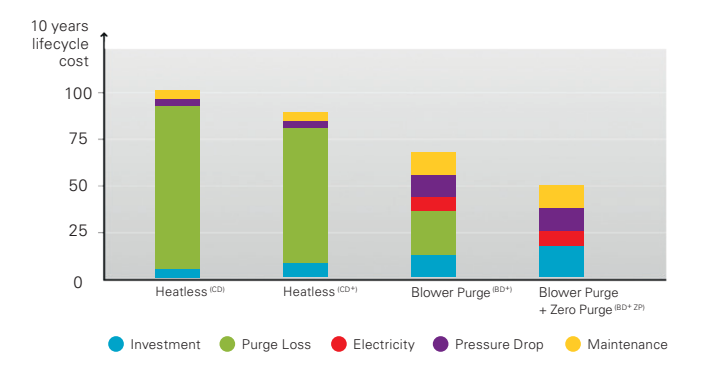
A heatless desiccant dryer is more expensive to own because
it uses a high amount of compressed air for purging during
regeneration. Typically, purge air takes up 16% to 19% of the
rated flow capacity of a heatless dryer. However, the heatless
dryer remains a popular choice because of its simplicity and
reliability.
Site conditions
Because of their simple design, heatless desiccant dryers are often preferred for extreme environments. This includes remote areas, hazardous sites with explosive gases and powders, and applications with a high inlet air temperature.
Superior energy efficiency
Reduced pressure drop below 0.2 bar/2.9 psi
A dryer’s energy consumption is determined by its internal pressure drop and the efficiency of its regeneration process. If a desiccant dryer experiences a high pressure drop, the compressor discharge pressure must be set higher, which increases energy and operating costs. Atlas Copco BD and CD desiccant dryers offer a very low pressure drop – below 0.2 bar/2.9 psi for most models – as well as the most efficient regeneration process.
Dewpoint Dependent Switching for energy savings up to 90%
Atlas Copco’s BD and CD desiccant dryers incorporate state-of-the-art energy management control with built-in Dewpoint Dependent Switching. The principle is simple. A dewpoint sensor will delay switching towers until dryer conditions require it. This cycle time extension can generate energy savings of up to 90%.
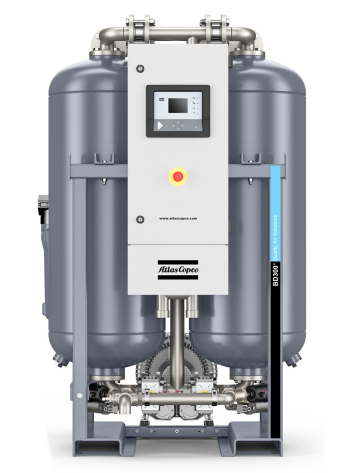
BD 100+-300+ Premium performance & cost-efficiency
Quality desiccant
- High adsorption silica gel desiccant needs less reactivation energy than other drying agents.
- Dual-layer desiccant bed with a water-resistant bottom layer protects the high-performance top layer.
- Pressure dewpoint of -40 °C/-40 °F as standard (-70 °C/-100 °F optional).
- Up to 30% extra desiccant to deliver consistent performance even in harsh conditions such as high temperatures and temporary overloads.
Stainless steel valves
High-performance stainless steel butterfly valves with actuators ensure a long lifetime.
Low wattage density heater
- Stainless steel design ensures a long lifetime.
- Heater is installed in an insulated pipe for an energy-efficient set-up.
- Insulated vessels are available as an option to further reduce heat losses and increase overall efficiency (standard on the -70 °C/-100 °F model).
Galvanized piping with flanged connections
- Flanged piping simplifies maintenance and minimizes the risk of leaks.
- Pipe sizing is optimized to ensure a low pressure drop for maximum energy savings.
Filters
- A pre-filter prevents oil contamination to increase desiccant lifetime.
- An after-filter protects the airnet from desiccant dust and network contamination.
- Can be mounted directly on the inlet and outlet of the dryer for low pressure drop.
- Easy to assemble and maintain. No extra piping and filter connections are required.
Advanced control and monitoring system
- Fitted inside an IP54 cubicle for easy cabling and safety.
- Monitors all parameters to ensure maximum reliability.
Dewpoint Dependent Switching
- Real pressure dewpoint monitoring (hygrometer).
- Pressure dewpoint (and alarm).
- The dryer will only switch to the next tower when the desiccant is saturated, as measured by the dewpoint sensor. During this cycle time extension, the dryer consumes no purge air, resulting in a significant reduction in energy use.
Robust and compact design
- Standard frame, including forklift slots and lifting eyes for easy handling.
- Wide vessels ensure a low air speed and a longer contact time.
- Flanges connecting the vessels are integrated into the top and bottom shells, lowering the total unit height.
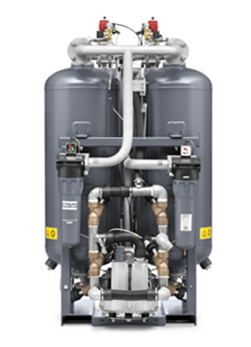
ZERO PURGE, MAXIMUM ENERGY SAVINGS
Looking for the desiccant dryer with the lowest operating costs? The BD+ Zero Purge is your best choice. With zero purge losses and minimal electricity use, the BD+ ZP offers the highest energy savings. Our lifecycle cost comparison on page 5 quantifies the differences.